
Rovinj

Rovinj

The pearl of Istria

Rovinj - the pearl of Istria

Rovinj (Italian: Rovigno) is a town in Croatia. It lies on the west coast of Istria. Together with Poreč it is Istria's strongest tourist centre and one of the strongest on the Adriatic. The area of the town of Rovinj borders the municipalities of Bale, Kanfanar, Sveti Lovreč and Vrsar.

The first mention of Rovinj, as Castrum Rubini, as far as is known, is found in the work “Cosmographia” by the Anonymous of Ravenna. The work, from the 7th century, with a wealth of geographical data relating to the 5th century, led the Rovinj chronicler Benussi to conclude that Rovinj came into being between the 3rd and 5th centuries. According to archaeological finds, the surroundings of present-day Rovinj were already inhabited in prehistoric times - the Bronze and Iron Ages - when the culture of the Histri flourished in Istria, who lived here and traded with the Greeks and Etruscans. The latest chance finds point to the existence of life already at the turn of the 2nd to the 1st millennium BC on the island itself (a peninsula since 1763) on which present-day Rovinj is located.

Because of its legacy of rich history and distinctive location, Rovinj is today one of the most attractive and most beautiful towns in the Mediterranean. The town radiates a unique beauty that attracts visitors from all over the world.
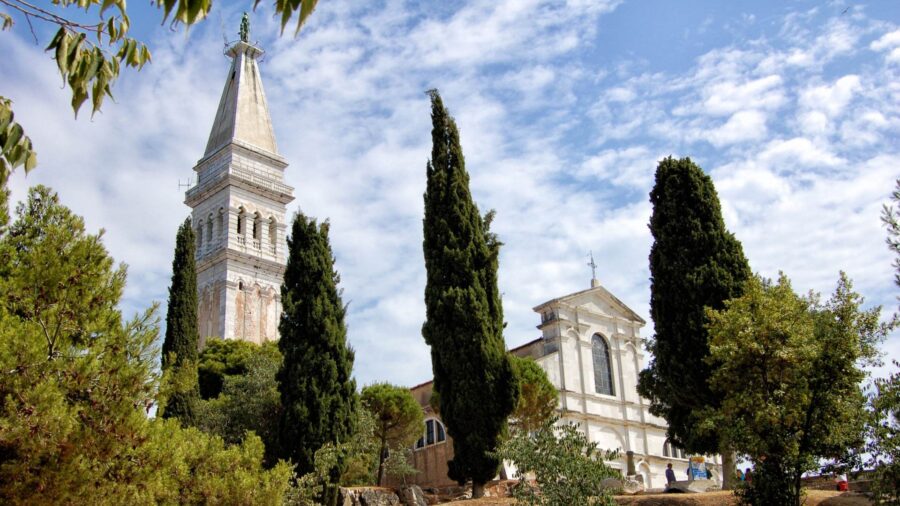
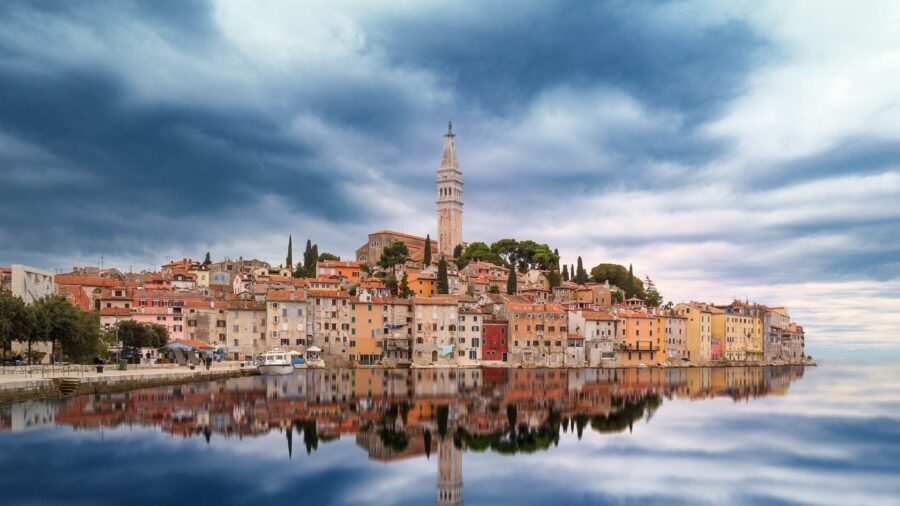
Rovinj, view of the old town and the bell tower of the Church of St Euphemia

Church of St Euphemia

Ever since, in the early dawn of 13 July 800, a marble sarcophagus with the body of St Euphemia miraculously floated to the Rovinj shore, Rovinj has been inseparably linked with this martyr. And just as the panorama of Rovinj is unimaginable without the tall, slender bell tower of her church, with the statue of the saint at the top that seems to keep watch high above the rooftops, climbs, steps, pines and seagulls, keeping company only with the clouds and the stars - so is its long history. The bell tower was built from 1654 to 1680 modelled on the one on St Mark's Square in Venice. It was built to a design by the architect Manopola, and in 1758 a copper statue of St Euphemia, the work of the brothers Vincenzo and Bista Vollani, was placed at its top. To build a church of such large dimensions on the plateau above the old town, it was necessary to demolish the late antique church of St George and two others - St Ursula and St Michael. The large Baroque church of St Euphemia, with three naves and three apses, was built from 1728 to 1736 to plans by the Venetian architect Giovanni Dozzi. Countless people, rivers of pilgrims, flowed for centuries from all over Istria, especially on the saint's feast day (16 September), to her church, to the sarcophagus in which the body of the holy virgin is kept.

Before this sarcophagus people made and fulfilled vows, prayed and gave thanks, repented and lit candles, in the rapture of sincere popular faith that largely preserved this people on its roads of the cross, meagre red soil and historical winds.

Call Transfers Enquiry